
Aufgabenstellung: Ich weiß, wo ich mich befinde (Lat / Long, ist ja aus den Smartphones easy herauszubekommen) und habe einen Radius in km, in dem ich POI’s mit der Open Streemap API suchen möchte.
Problem: Die OSM API bietet keine (mir bekannte) Möglichkeit, um meinen aktuellen Standort herum eine Radius-Suche in km auszuführen, sondern hätte gern eine Bounding Box angegeben, die die Ecken der Box als Geo-Koordinaten angibt – siehe hier:
http://www.overpass-api.de/api/xapi?node[bbox=8.62,49.85,8.68,49.89][amenity=fast_food|pub][@meta]
Dabei spezifiziert der Parameter bbox die Lat/Long-Koordinaten in der Reihenfolge links, oben, rechts, unten.
Dazu erstmal zum Verständnis:
- Der Breitengrad (Latitude) gibt die Nord-Südachse an, „50“ ist nördlicher als „49“
- Der Längengrad (Longitude) gibt die Ost-Westachse an, „5“ ist westlicher als „6“
Berechnung
Nun haben wir also den eigenen Standort, wissen über Lat/Long Bescheid und wollen die Eckpunkte für die oben angesprochene Bounding Box errechnen. Aufbauend auf diesem Artikel habe ich folgende PHP-Funktion gebaut:
$lat = 49.869059;
$lon = 8.645318;
$radius = 1.5;

/**
 * lat (breitengrad = nord -> sued): 50 ist noerdlicher als 49
 * lon (längengrad = west -> ost): 5 ist westlicher als 6
 */
function getBoundingBox($lat, $lon, $radius)
{
	$earth_radius = 6371;
	$maxLat = $lat + rad2deg($radius/$earth_radius);
	$minLat = $lat - rad2deg($radius/$earth_radius);
	$maxLon = $lon + rad2deg($radius/$earth_radius/cos(deg2rad($lat)));
	$minLon = $lon - rad2deg($radius/$earth_radius/cos(deg2rad($lat)));

	return array
	(
		"center" => array("lat" => $lat, "lon" => $lon),
		"nw" => array("lat" => $maxLat, "lon" => $minLon),
		"ne" => array("lat" => $maxLat, "lon" => $maxLon),
		"sw" => array("lat" => $minLat, "lon" => $minLon),
		"se" => array("lat" => $minLat, "lon" => $maxLon)
	);
}

$coords = getBoundingBox($lat, $lon, $radius);

print_r($coords);
/*

Array
(
    [center] => Array
        (
            [lat] => 49.869059
            [lon] => 8.645318
        )

    [nw] => Array
        (
            [lat] => 49.882548824089
            [lon] => 8.6243885076019
        )

    [ne] => Array
        (
            [lat] => 49.882548824089
            [lon] => 8.6662474923981
        )

    [sw] => Array
        (
            [lat] => 49.855569175911
            [lon] => 8.6243885076019
        )

    [se] => Array
        (
            [lat] => 49.855569175911
            [lon] => 8.6662474923981
        )

)
*/
Somit haben wir schonmal die Eckpunkte für den Radius 1,5km um unseren Mittelpunkt ausgerechnet.
Darstellen der Eckpunkte auf einer Google Map
Zur Verifikation der errechneten Eckpunkte muss Quick&Dirty eine googlemap herhalten (inspiriert von hier).
<!DOCTYPE html>
<html>
<head>
<link rel="stylesheet" href="http://code.google.com/apis/maps/documentation/javascript/examples/default.css" />
<script src="http://maps.googleapis.com/maps/api/js?sensor=false"></script>
<script>
	function init()
	{
		var markers = [];

		<?php
		foreach ($coords as $desc => $latlong)
		{
		?>
			markers.push({
				'lat' : <?php echo $latlong['lat']; ?>,
				'lon' : <?php echo $latlong['lon']; ?>,
				'desc' : "<?php echo $desc; ?>"
			});
		<?php
		}
		?>

		var map = new google.maps.Map(document.getElementById("map_canvas"), {
			zoom: 11,
			center: new google.maps.LatLng(<?php echo $coords['center']['lat'] . "," . $coords['center']['lon']; ?>),
			mapTypeId: google.maps.MapTypeId.ROADMAP
		});

		for (var i = 0; i < markers.length; i++) {
			new google.maps.Marker({
				position: new google.maps.LatLng(markers[i].lat, markers[i].lon),
				map: map,
				title: markers[i].desc
			});
		}
	}

  window.onload = init;
</script>
</head>
<body>
	<div id="map_canvas"></div>
</body>
</html>
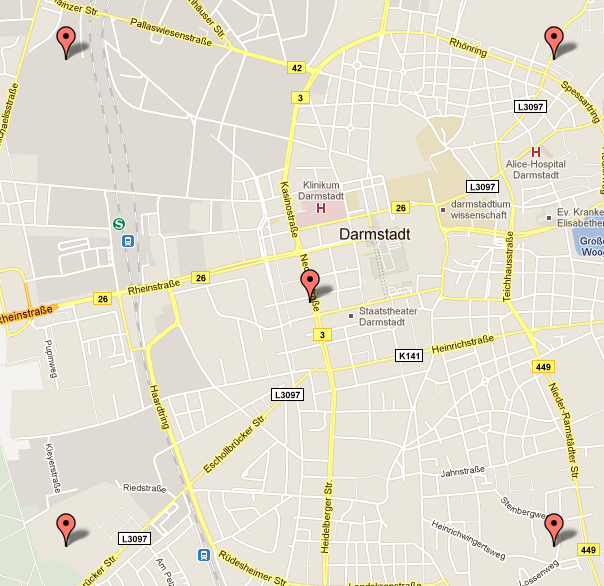
radius
Sieht doch gut aus. Somit haben wir unsere Bounding Box Koordinaten auch visuell dargestellt und können die OSM API damit füttern.
Und hier nochmal der komplette Code:
<?php
$lat = 49.869059;
$lon = 8.645318;
$radius = 1.5;

/**
 * lat (breitengrad = nord -> sued): 50 ist noerdlicher als 49
 * lon (längengrad = west -> ost): 5 ist westlicher als 6
 */
function getBoundingBox($lat, $lon, $radius)
{
	$earth_radius = 6371;
	$maxLat = $lat + rad2deg($radius/$earth_radius);
	$minLat = $lat - rad2deg($radius/$earth_radius);
	$maxLon = $lon + rad2deg($radius/$earth_radius/cos(deg2rad($lat)));
	$minLon = $lon - rad2deg($radius/$earth_radius/cos(deg2rad($lat)));

	return array
	(
		"center" => array("lat" => $lat, "lon" => $lon),
		"nw" => array("lat" => $maxLat, "lon" => $minLon),
		"ne" => array("lat" => $maxLat, "lon" => $maxLon),
		"sw" => array("lat" => $minLat, "lon" => $minLon),
		"se" => array("lat" => $minLat, "lon" => $maxLon)
	);
}

$coords = getBoundingBox($lat, $lon, $radius);
?>

<!DOCTYPE html>
<html>
<head>
<link rel="stylesheet" href="http://code.google.com/apis/maps/documentation/javascript/examples/default.css" />
<script src="http://maps.googleapis.com/maps/api/js?sensor=false"></script>
<script>
	function init()
	{
		var markers = [];

		<?php
		foreach ($coords as $desc => $latlong)
		{
		?>
			markers.push({
				'lat' : <?php echo $latlong['lat']; ?>,
				'lon' : <?php echo $latlong['lon']; ?>,
				'desc' : "<?php echo $desc; ?>"
			});
		<?php
		}
		?>

		var map = new google.maps.Map(document.getElementById("map_canvas"), {
			zoom: 11,
			center: new google.maps.LatLng(<?php echo $coords['center']['lat'] . "," . $coords['center']['lon']; ?>),
			mapTypeId: google.maps.MapTypeId.ROADMAP
		});

		for (var i = 0; i < markers.length; i++) {
			new google.maps.Marker({
				position: new google.maps.LatLng(markers[i].lat, markers[i].lon),
				map: map,
				title: markers[i].desc
			});
		}
	}

  window.onload = init;
</script>
</head>
<body>
	<div id="map_canvas"></div>
</body>
</html>
 Mein Name ist
Eine Antwort auf Umkreissuche: Lat/Long und der Radius